Contents
10.9. regexp
关于字符串的操作,除了strings提供的基本操作外,还包括一个与字符串相关的重要操作一一搜索。对字符串按指定规则进行搜索,可以使用正则表达式。
Go标准库使用RE2语法,RE2语法也是Python、C和Perl使用的正则表达式语法。 Go的正则语法和Python类似。
10.9.1. 1.正则表达式主要规则表
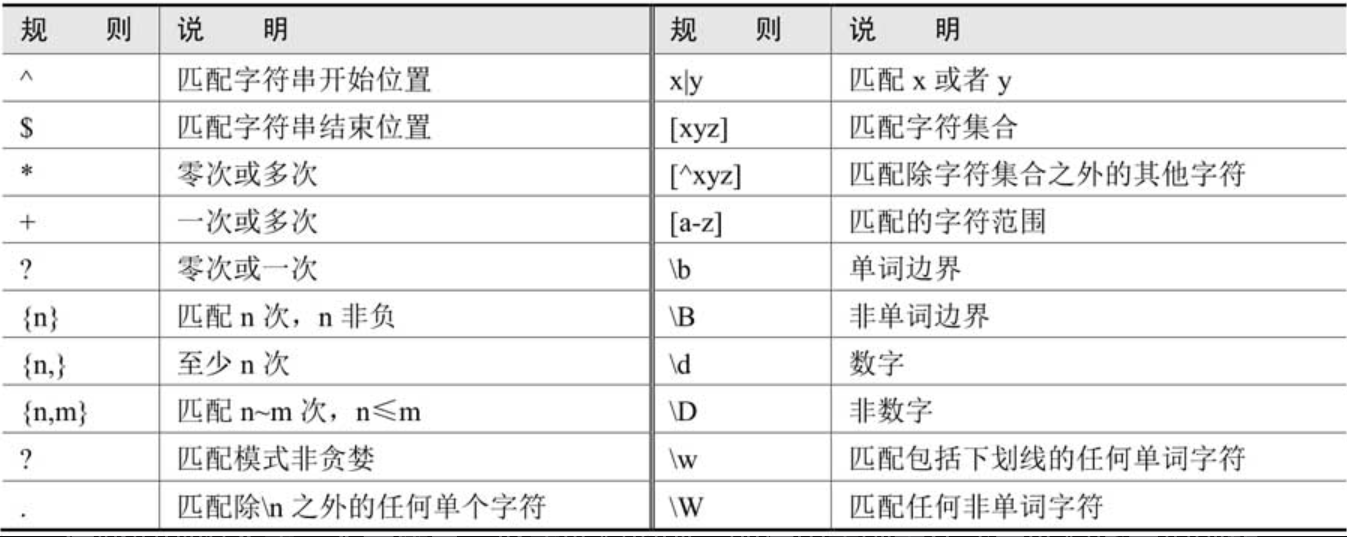
这些规则组合成一个字符串,形成匹配规则,即使用正则表达式来匹配指定规则的内容。
10.9.2. 2. 使用正则表达式

2.1 常用函数
MatchString()
FindString()
FindStringIndex()
FindStringSubmatch()
ReplaceAllString()
Compile()
MustCompile()
FindAllString()
2.2 MatchString
如果字符串中有子字符串与正则表达式匹配,返回true,否则返回false。
package main

import (
    "fmt"
    "regexp"
)

func main() {
    str := "To be or not to be, that's a question."
    // 判断str是否是以To开头
    m, err := regexp.MatchString(`^To`, str)
    fmt.Println("Match:", m, "Error:", err)
}
2.3 FindString
返回第一个匹配的结果。 如果没有匹配成功,返回一个空的字符串。
package main

import (
    "fmt"
    "regexp"
)

func main() {
    str := "Golang expressions example"
    r, _ := regexp.Compile("Gola([a-z]+)g")
    fmt.Println(r.FindString(str))  // Golang
}
2.4 FindStringIndex
FindStringIndex()可以得到匹配的字符串在整体字符串中的索引位置。如果没有匹配的字符串,它回返回nil。
package main

import (
    "fmt"
    "regexp"
)

func main() {
    str := "Golang regular expressions example"
    r, err := regexp.Compile(`exp`)
    if err != nil {
        fmt.Println(err)
    }
    match := r.FindStringIndex(str)
    fmt.Println("Match: ", match, "Error: ", err)
}
2.5 FindStringSubmatch
FindStringSubmatch() 除了返回匹配的字符串外,还会返回子表达式的匹配项。 如果没有匹配项,则返回nil。
package main

import (
    "fmt"
    "regexp"
)

func main() {
    str := "Golang regular expressions example"
    r, err := regexp.Compile(`p([a-z]+)e`)
    match := r.FindStringSubmatch(str)
    fmt.Println("Match:", match, " Error:", err)
}

// Match: [15 18] Error: <nil>
2.6 FindAllString
FindString方法的All版本,它返回所有匹配的字符串的slice。 如果返回nil代表没有匹配的字符串。
package main

import (
    "fmt"
    "log"
    "regexp"
)

func main() {
    str := "Golang regular expressions example"
    r, err := regexp.Compile(`p([a-z]+)e`)
    if err != nil {
        log.Fatalln(err)
    }
    match := r.FindAllString(str, 2)
    fmt.Println("Match: ", match, " Error: ", err)
}
2.7 ReplaceAllString
ReplaceAllString 用来替换所有匹配的字符串,返回一个源字符串的拷贝。
package main

import (
    "fmt"
    "log"
    "regexp"
)

func main() {
    str := "Golang regular expressions example"
    r, err := regexp.Compile(`examp([a-z]+)e`)
    if err != nil {
        log.Fatalln(err)
    }
    match := r.ReplaceAllString(str, "tutorial")
    fmt.Println("Match: ", match, " Error: ", err)
}

// Match: Golang regular expressions tutorial  Error: <nil>
10.9.3. 3.Find系列函数
当方法名中有All的时候,它回继续查找非重叠的后续的字符串,返回slice。
当方法名中有String的时候,参数设计字符串,否则时byte slice。
当方法名中有Submatch的时候,还会返回子表达式(capturing group)的匹配项。
综合示例
package chapter4

import (
    "fmt"
    "regexp"
)

func SimpleUsage() {
    Slogan := "Go is an open source programming language that makes it easy to build simple, reliable, and efficient software."

    reg, _ := regexp.Compile("open source programming language")
    if reg.Match([]byte(Slogan)) {
        fmt.Println("byte: Match")
    }

    if reg.MatchString(Slogan) {
        fmt.Println("string: Match")
    }

}

func SearchUsage() {
    Slogan := "Go is an open source programming language that makes it easy to build simple, reliable, and efficient software."

    reg, _ := regexp.Compile("open source programming language")
    v := reg.Find([]byte(Slogan))
    fmt.Println(string(v))

    v2 := reg.FindString(Slogan)
    fmt.Println(v2)
}

func ReplaceUsage() {
    Slogan := "Go is an open source programming language that makes it easy to build simple, reliable, and efficient software."

    reg, _ := regexp.Compile(`^Go`)
    result := reg.ReplaceAllString(Slogan, "Python")

    fmt.Println(result)
}

func SplitUsage() {
    Slogan := "Go is an open source programming language that makes it easy to build simple, reliable, and efficient software."

    reg, _ := regexp.Compile(`\s|\,|\.`) // 按" "、","、"." 分割

    result := reg.Split(Slogan, -1)
    fmt.Println(result)
}
10.9.4. 4. 小结
regexp库提供了匹配(Match_X)、搜索(Find_X)、替换(Replace_X)和分割(Split)等功能,完成这些任务有以下两个关键点:
(1)使用Compile函数编译正则表达式。
(2)编写符合场景的匹配规则,匹配规则又取决于开发者对正则表达式的熟悉程度。